On the Prince of Darkness: Etymology

The English phrase “Prince of Darkness” is a translation of a Latin phrase, princeps tenebrarum

Princeps is a noun meaning “First one” or “Leader.” It would, in time, expand in meaning to include ideas such as “first in time or order; the first, chief, the most eminent, distinguished, or noble; the first man, first person.” In Roman culture, Princeps was the title of the Emperor, meaning that he was the “First Citizen” of the Empire. Originally it was used in the title of Princeps Senatus, “First Among Equals,” which was a role in the Roman Senate. Caesar Augustus, upon becoming Emperor, chose princeps as his title in place of rex because he felt it would cause less concern and opposition, such as Julius Caesar had faced from the Senate. 

The title of princeps would be used in the Eastern Roman Empire. It eventually gave way to the contemporary word “prince” in English. While many now think of a Prince as the son of a King, the title was originally one of a pure sovereign in their own right. The use of a Prince as an heir apparent would not come into fashion until the 17th Century. 

Tenebrarum is the generative conjugation of the word Tenebrae, which in Latin means either “darkness” or “shadows.” The darkness to which tenenbrarum speaks is specifically the darkness of night or the kind of darkness which appears in the absence of light, such as in a prison or a cave. It is thought to derive from the Proto-Indo-European root “temes-” or “tem-.” “Temes-” as a root yields such words as the Sanskrit tamas “darkness” and similar sounding words in Avestan, Lithuanian, Old Irish, and Old Church Slavonic. Oddly the English word “temerity” means “excessive confidence,” “boldness,” or “audacity.” 

The construct of princeps tenebrarum is first found in a text known as Acta Pilati or The Acts of Pilate, which is sometimes titled the Gospel of Nicodemus. The book first appeared in Greek and included a description of the so-called “Harrowing of Hell,’ the descent of Jesus to Hell following his death to free those contained there. A final short section of the text claims to be an official report from Pontius Pilate to Rome discussing the Jewish refusal to accept Jesus as a manifestation of their God. In the context of the Harrowing of Hell, the term princeps tenebrarum is used in relation to Satan. The book is thought to originate around 150 CE and takes its present form in the 4th Century CE.

Princeps tenebrarum appears in the 11th Century hymn Rhythmus de die mortis by Pietro Damiani

Falsa tunc dulcendo carnis in amarum uertitur,
Quando beuem uoluptatem perpes poena sequitur.
Iam quod magnum credebatur, nil fuisse cernitur.
8. At quae mens in summae lucis gloriam sustollitur,
Aspernatur lutum carnis, quo mersa prouoluitur,
Et ut carcerali nexu laetabunda soluitur.
9. Sed egressa durum iter experitur anima,
Quam incursant furiosa dirae pestis agmina
Et diuersa suis locis instruunt certamina.
10. Nam hic incentores gulae, illic auaritiae,
Alibi fautores irae, alibi superbiae;
Vitii cuiusque globus suas parat acies.
11. Iam si cedat una turma, mox insurgit altera.
Omnis ars temptatur belli, omnis pugnae machina,
Ne ad hostium pudorem sic euadat anima.
12. O quam torua bellatorum monstra sunt feralium!
Taetri, truces, truculenti flammas efflant naribus,
Dracontea tument colla, uirus stilant faucibus.
13. Serpentinis armant spiris manus doctas proeliis;
His oppugnant aduentates telis uelut ferreis,
His quos attrahunt, aeternis mancipant incendiis.
14. Quaeso, Christe, rex inuicte, tu succurre misero
Sub extremae sortis hora, cum iussus obiero.
Nullum in me ius tyranno praebeatur impio.
15. Cadat princeps tenebrarum, cedat pars Tartarea.
Pastor, ouem iam redemptam tunc reduc ad patriam,
Vbi te uiuendi causa perfruar in saecula.
Amen.

Here the Prince of Darkness is referred to as the yield of Tartarus, the Greek Underworld, which functioned as an alternate term for Hell.


The phrase also appears in the 12th Century “Sermones in Cantica canticorum” by Bernard of Clairvaux (1090 – 1153 CE).

 Accepit tamen Satan regnum super omnes filios superbiae, factus princeps tenebrarum harum, ut regno humilitatis etiam superbia militet, dum in uno suo principatu temporali, et tali, multos humiles excelsos aeternosque reges constituit.
_____
The kingdom of Satan, however, took over all the sons of pride, he was made the ruler of the darkness, in order to serve the kingdom of humility, pride, even when, his temporal sovereignty, and such a one, on the haughty to the humble aeternosque many of the kings he appointed.

It would appear that the phrase princeps tenenbrarum was a term that entered early into the Church and was retained through its first millennium.
The Secret Rule of Satan and the Witches

The expanding Church’s experience in the late Middle Ages created encounters with many hold-over features of pre-Christian tradition and many aberrations to the Faith due to isolated developments. This would coalesce at the start of the Early Modern Period into a concern about rural folk who were in league with the Devil, known as Witches.

Anthropologists such as Rodney Needham see beliefs in malevolent sorcerers who may or may not be aware of their condition as such as a near-universal feature of human cultures. In much the same way anthropologists have generalized the term Shaman to denote a specific type of universal ritual specialist, they have also universalized the title of Witch for these malevolent sorcerers. The notion of Witches as malevolent magicians goes back to Greek sources and had a significant explosion during the Roman Empire, only to vanish for the most part during the Middle Ages. In the Early Modern Period, this universal feature, combined with Classical sources and Biblical notions from Revelation, would suture together as the notion of Witches and Witchcraft being a pervasive, underground movement in European culture. For a complete introductory account of this phenomenon, see Witchcraft: a Very Short Introduction by Malcolm Gaskill for the Oxford University Press.

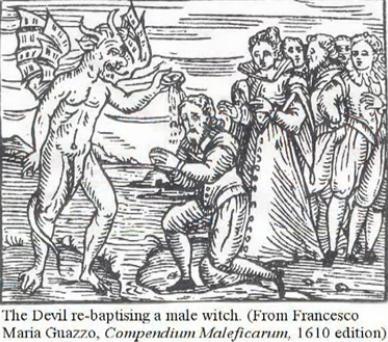
Unlike the Righteous Scholar Magicians working with the Hermetica, Witches were seen as being in league with Satan himself. Through renouncing the True Faith in favor of the unholy sacraments of the Devil, the Witches became part of a community that had done the same as He, pursuing their own independent ends (telos) against those of God. A complex mythology fusing ideas from Late Antiquity, including the accusations against Christians of child sacrifice and ritual murder, with remnant ideas from Paganism, emerged outlining the practices of Witches, with Malleus Maleficarum being the essential text in this genre.

This notion of the Witch combined rampant misogyny fueled by fear of mature, sexually independent women with the relatively new belief in the Secret Rule of Satan. Where the Righteous Magician Scholars were primarily men of high social standing, most of those accused as Witches were women. Typically they were considered “elderly,” which could mean anything from late 20s to 40s, and were unattached to a male figure either from never marrying or being a widow, making them potentially sexually autonomous. Fears of what sexually autonomous women might engage in for their own desires became fears of how Satan might use their licentiousness against the One True Faith.

To account for the failings of the Faith, or its Reformations, suspicion turned to dissension within the Faith’s own ranks. In addition to the fear of Witches amongst lower-status peasants, an equally disturbing image of such people being in positions of power also emerged. While far more rare than accusations against the powerless, those with tremendous power would sometimes be accused of being Witches and thus in league with the Devil. Gilles de Rais, Urbain Grandier, and others would follow in the footsteps of Pre-Modernity’s diabolically accused Knights Templar in being executed for their supposed allegiances to the Devil.

The fear of Witches and those in league with the Devil would permeate the Early Modern Period. As the communities of Christians began to splinter, these accusations would increase tremendously, inspired by a belief that these splinter groups were not fulfilling prophecy due to forces working directly against them. The new construction of Satan, thanks to the Witch Craze, would combine the action of the Witches at the lowest rungs of society with the high-level subversions of Faith being seen, real or imagined, by the opposition within the Christian faiths.

Saturday Quote

“Rather [Remanifest] invokes the dialectic idealism of Hegel, suggesting that the sort of evolution proposed by Xeper will actually occur in a series of syntheses. What differentiates Remanifest from Hegel, of course, is that Hegel offered his dialectic idealism on a universal scale, manifest among humanity as the state. [Remanifest’s Magus] states that, while the principle of dialectic idealism is correct, it is to the individual consciousness that it pertains.”

Dr. Michael A Aquino “Towards Telos” August 1990

The Early Modern Period and the Secret Rule of Satan

Some background is in order to get a sense of the world we are entering into in discussing John Dee.

During the third period of expansion of early Islam, circa 661-750 EV, the entire extent of North Africa came under the control of the Umayyad Caliphate. From here, it became quite easy to stage an entry into the Iberian Peninsula, present-day Spain and Portugal, which was conquered and brought under the Umayyad administration. When the Umayyad Caliphate collapsed, its administration in Iberia would reorganize as the Caliphate of Córdoba, ruling from 929 – 1031 EV.

The Caliphate of Córdoba was relatively liberal with its interpretation of the Islamic idea of “People of the Book,” The Iberian Peninsula became a haven for European Jews, unorthodox Christians, and non-Abramaic “Pagan” thinkers. Though second-class citizens, they were allowed to operate openly, and the exchange of ideas and information within the city centers was high. Practices of later importance, such as the Jewish Kabbalah and the first stirrings of Christian appropriation of these ideas, were first developed in this area.

As a hotbed of ‘Unbelievers,” Córdoba would become the target of the growing forces of Western Christianity. Córdoba’s internal struggles would lead to a collapse circa 1031 EV into smaller kingdoms and, over the next few centuries, saw the shrinking of Islam’s influence in Iberia. Finally, in 1492 EV, Iberia was “Cleansed” of Islam via the “Reconquista.” With the heathens beaten back and the new unification of the Spanish kingdoms, Imperial Spain, convinced of its place as the Final Kingdom, began.

1492 EV marked two significant incidents in the history of Imperial Spain that would shape the World to come. The most well-known was the financing of the explorer Christopher Columbus in his attempt to find a trans-Atlantic route to the Far East, leading to the Renaissance Era discovery of the Western Hemisphere. Less well known was the expulsion of all Jews from Spain, as the attempts to force conversion of Jews and other non-Christians under the Spanish Inquisition had failed to purify Spain to rule the Millennium.

The discovery of the “New World” in the Western Hemisphere would shatter many cherished beliefs but would also suture new ones. The European nations’ race for Imperial Power in this New World was pushed as much by a desire to be the Final Kingdom as it was more conventional economic gain. Here were entire continents of non-believers who needed to be brought the Gospel, as had been foretold (if you looked long enough and hard enough) in prophecy. These discoveries brought about questions regarding the utter lack of an account of these continents within Scripture, opening a doorway for skepticism regarding the veracity of these documents. Questions regarding the suitability of the Western Church to act as the representative of the “One True Faith” began to emerge, and old concerns about the purity of the Curia in Rome and its practices were sowing doubts throughout Europe.

By the beginning of the 16th Century, the Old World’s definitions of itself were withering under the weight of discovery. The time was ripe for new visions to emerge within this “brave new world.” 

The period we are now discussing termed the Early Modern Period, spanned between 1450 EV and 1850 EV, though, as always, the exact beginnings and endings are arguable. The beginning of this period is tied to the end of the Crusades and the general unification of the Western Church in Europe.

This would be important as the newly unified Church, fortified by its military experiences in the Crusades, would expand outwards into areas of Europe that had, for the most part, been left fallow as far as enforcement of faith and, as such, tended to be places where bits of archaic religious practices formed syncretic systems with a decidedly unsophisticated form of Christianity.

The changes that the Crusades had made necessary within the major centers of Europe had become a new normal. Large sea vessels capable of moving troops and supplies, now without Holy War, began looking for new opportunities. Systems developed to support military transport and pilgrims, such as banking, began to look for new means of applying the skills they now held.

In addition, those within the major centers began to question the spiritual mandate that the Church in Rome held. Were these individuals truly representative of the teaching of Christ, or had they come to embody something of less transcendent value? If they had given up their mandate, would it be possible for others to take it up, purifying the faith and undermining their temporal authority?

It would be the religious tensions that burst forth first. While Spain had looked to purge itself of unbelievers in the 15th Century through alignment with the Roman Catholic Church, the 16th Century would see kingdoms aligning themselves with newly formed independent strains of Christianity lumped under the umbrella of Protestantism. Martin Luther’s 1517 act of writing and publicizing his “Ninety-Five Theses” under the impression that he was purifying a faith corrupted by Catholic Power set off a chain of such separations throughout Northern Europe. Figures such as John Calvin would lead additional theological transformations of Christianity. At the same time, Henry VIII of England coalesced developing calls for reform in England with concerns over his temporal authority to produce the Church of England.

The Book of Revelation took on a new meaning in this time period. Not only could a given kingdom see itself as the Final Kingdom, but the fracturing of Christianity seemed to reflect Revelation’s warning against false Churches and false Christs. One’s temporal enemies were more than just that; they were in league with Satan, who, until the Early Modern Period, had not had much influence upon Christian thought.

The figure of Satan originates within the Hebrew Scriptures. His one undisputed appearance is in the Book of Job, a text thought to originate sometime between the 6th and 4th centuries BCE. There one finds the figure of Satan as a member of God’s Court who has the task of challenging God and his faithful. The text contains many common Levantine themes, including a tale of righteous suffering and accounts of a conflict between the high god, in this case, Yahweh, and a primordial watery serpent force, in this case, Leviathan.

Outside of the canonical texts of the Hebrews, the figure of Satan would undergo some elaboration, accounted for in the texts forming a part of the Hebrew Apocrypha. The First and Second Book of Enoch plays the most critical role in fleshing out the rather vague figure of the Scriptures. Here the mythology of fallen angels, with Satan as their leader, takes shape, a concept not found in Hebrew Scriptures. The exact dates for these books are unknown though they are believed to show influence from Zoroastrian sources.

Satan would gain a bit more space in the texts of the Christian Scriptures, but not by much. The synoptic Gospels of Matthew, Mark, and Luke recounted that Jesus interacted with Satan during a time of solitude in the desert, where Satan was described as offering him the rule of the earth, suggesting it was something that he could give. Issues related to demonic forces arise on occasion in relation to Jesus’ Ministry, such as accusations that he was using the god Beelzebub to cast out demons. Satan’s leading role, however, was to be found in the Book of Revelation, where in the end times, he would raise up a Kingdom of Falsehood with tremendous temporal authority who would persecute the faithful, lead a War in Heaven, and be cast down into the Pit.

In the Middle Ages, the figure of Satan was given the iconography of horns, goat feet, and items such as pitchforks. In general, he was more a figure of mirth than a being seen as a real threat. When periodic accusations of Devil activities were made, it was more often than not the Church authorities that dismissed them as superstition among peasants. The Light of the True Church reigned, so what had Christians to fear of Satan?

The changes underway in the early Modern Period would radically transform these standing traditions. Looking for explanations for those holding differing theologies, vying for temporal power, and a need to explain those largely powerless individuals in the rural territories engaging in “degenerate” practices would lead to a new mythology: The Secret Rule of Satan and the hidden powers of his Church in the World.

The Spectral Janitor of Academy 23 (i)

Since the fall I have been finding myself looking over the remains of “Academy 23,” the hypothetical school of magic inclusive of figured such as William S. Burroughs, Brion Gysin, Robert Anton Wilson, and Genesis P-Orridge. It’s now roughly 23 months since P-Orridge’s death*, meaning the collapsed remains of the Academy has had some time to cool off. All four of the names mentioned above were influences on my early Initiation, and I touched hands with three of the four. Only one of them was not, on balance, a terrible person in fundamental ways.

The best way to honor the past is not through venerating only its good points. In the manner of IO, who slays Apep, the best way to properly honor the past is through making the way for the Real. That means not flinching from their limitations, failures, and worst traits. It also means having a sense of the influences they had and influence they have cast across culture and subcultures.

This will not be a systematic exploration by any means. I expect it will arise in waves as interest, access, and focus shift. Yet it is one of those themes running in the background of my thinking at the moment, and I know well enough that making those things into material others can Work with has a value.

With that, Captain Clark welcomes you aboard. 

We are here to go.

*This piece was originally written on January 20, 2023 

Theoria: The Essentials of the Semiotic Theory of Magic

Acts of Magic, of whatever kind, are acts of Communication.

A Basic Model of Communication

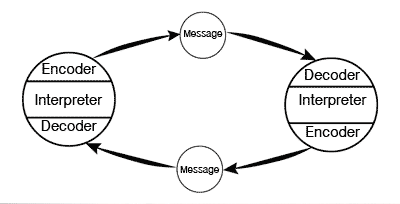
   One of the most valuable communication models was proposed in 1954 by Charles Osgood and Wilbur Schramm.

The most common in interpersonal communication is through language. Communication takes place between Interpreters with a cyclical exchange. In a single act of communication, one of the Interpreters acts as the Encoder. This individual takes some Message and puts it through a code. The encoded message is then transmitted in some fashion to the other Interpreter, who acts as the Decoder. As long as they know the Encoder’s code, they can decode it and receive the intended message. Once a cycle like this is complete, it repeats in the other direction, creating a circular feedback system.

You might notice a place where problems can arise. What happens if the Encoding Interpreter uses a code the Decoder does not know? In that situation, the Message will not be received at all. What happens if the Decoder only understands part of the code being used? They will delete and distort content from the encoded Message. They will likely generalize from what they do understand or have experienced in the past. This communication model will be the primary model I will be using throughout the discussion. I will add to it from other Communications Studies resources. Still, the Osgood-Schramm Model will be the basic I will return to repeatedly.

Communication Studies is a complex field with a curious history, drawing from psychology, philosophy, and other intellectual disciplines. It is outside the scope of this series to go into full detail. Still, I encourage you to do your independent research in this area.

This model shows that encoding is a central aspect of communication. Indeed, the creation of acts of magic comes from clearly identifying desires, seeing how to define them as intents, and then encoding this intent in a fashion that is resonant with your self of magic. For those fluent in a specific tradition or neo-tradition of magic, this process of encoding will often fit within the semiotic structure of that tradition. For this series, however, I assume you are not fluent in any tradition/neo-tradition. Thus, it would be best to devise your own means of encoding desires. 

The practice of sigil magic is a practical, nontraditional way of starting. Regarding existing texts on sigil magic, Frater U.D.’s Practical Sigil Magic is the best primary text. Jan Fries’ Visual Magick is a worthwhile secondary text to challenge aspects of Frater U.D.’s thinking and thinking to expand the potential media for practice.

All sigil magic follows a relatively simple formula. Identify a desire and turn it into a declarative statement of intent. These are best formed as positive statements. There is a substantial benefit to forming these statements in a manner that J. L Austin termed a “performance utterance” in his seminal How to Do Things With Words. Once the statement has been formed, it is put through a process of encoding. These encodings can be via nearly any media. However, the two most common are visual and auditory, with kinesthetic or gestural methods less commonly discussed in the literature on sigil magic.

Once the sigil is formed, it is then enchanted through an act of magic. A period of preparation takes place, a time for the act is determined, compression takes place, a frame rite is performed, and in this magical space, the sigil is charged in some manner appropriate to its communication. Once this is complete, the frame ritual is used to close, and the intent is let go of by the magician to work.

Much has been made in the literature on sigil magic regarding the importance of forgetting the sigil’s intent. This isn’t nearly as necessary as has been suggested. It is essential not to be obsessive about the intent and continually call it to mind. Much like a farmer, you need to trust that once you have planted a well-tended and selected seed, it will germinate on its own, provided they give it the proper soil.

This covers the first direction of communication, at least in terms of the Encoder and the sending of the message, but what are we communicating with? As discussed previously, our message has two potential targets: the Inner Ring of Perception to engage in Metamorphosis and the Outer Ring of the Objective to engage in Sorcery.

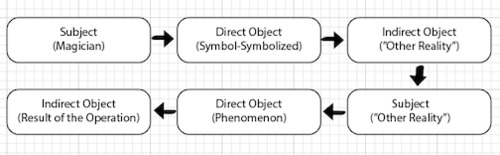
Dr. Flowers describes acts of magic drawn from the anthropologist Jan van Baal in his dissertation Runes and Magic.

Van Baal sees magic as a two-sentence affair. The first is the Magician communicating their encoded desire to the other reality (Inner or Outer). The second is the response from that reality through phenomenon providing the result of the original communication.

Dr. Flowers provides an interesting typology for acts of magic that are worth considering when identifying your desires. These categories are:

  • a) protection from destruction, forces, beings, etc. 
  • b) restoration of disturbed natural order, health, etc. 
  • c) preservation of natural order, health, etc. 
  • d) attraction of desired forces, beings, persons — invocations, evocations, love-magic, etc. 
  • e) destruction of intrusive forces, beings, persons — curses, etc. 
  • f) transformation of forces, beings, persons — initiation, shape-shifting, etc. 
  • g) perception of hidden reality — divination

It is important to note that these need not be isolated or exclusive categories. A blending of them is typical, such as attracting people capable of preserving a given project or looking to create the potential for transformation via the destruction of hindrances. Interestingly different traditions and styles of magic emphasize some of these more than others. Dr. Flowers notes that many surviving examples of runic magic deal with protection, restoration, and preservation. The magic of Anton LaVey, in contrast, deals almost exclusively with attraction, destruction, and restoration. You will likely find in practice that you rely more heavily upon some of these categories than others. This will provide you with both a sense of your strengths and those areas where you are weakest.

Recovering the Hermetica

Byzantine emperor Alexios I faced a seemingly insurmountable challenge in the 11th Century. Despite being the heir to the Roman Empire, Alexios I saw his area of rule diminishing with the expansion of the Seljuq dynasty.

The House of Seljuq was a Turkish family who practiced a Sunni variation of Islam that, in time, integrated features of Persian culture. With the unifying force of Islam, they had managed to expand their empire far and wide through the Middle East and into Central Asia. By the 11th Century, however, the Seljuq empire was fraught with internal conflict as local rulers attempted to consolidate their powers rather than form an integrated empire.

Alexios I did not have the manpower needed to fight off the Seljuq, so he made an appeal across the Schism to Urban II, the Pope in Rome. He wanted access to the armies of Western Europe under his command. What he got instead was the First Crusade.

The First Crusade was successful in fighting back the Seljuq in the Middle East and overtaking what Christianity was as “The Holy Land.” This return of the True Church to the Holy Land had opened the doorway for ideas like Joachim’s and other readings of Revelation suggesting that the End was at hand. New economic methods were developed to equip Crusaders, keep track of goods and supplies, and return found wealth to the ruling centers in Europe, which would, in time, yield the first transnational banking systems. It also brought Western European nations into significant contact with the Islamic World for the first time and, with it, restored access to texts from the Classical World, which had been thought wholly lost.

The changing vision of the meaning of the present, the shifting economic systems, and the return of “Lost Wisdom” fermented together, forming what has become known as the Renaissance. For Renaissance thinkers, the Classical World held all wisdom. The older, the better. While works of the Greeks, such as Aristotle and Plato, were seen as significant, the real prize, based upon Lactantius’ ideas on Hermes Trismegistus, was the Hermetica.

In the 15th Century, Marsilio Ficino was employed by Cosimo de Medici towards the re-founding of Plato’s Academy in Florence, Italy. He was engaged with the translation of Plato’s Dialogs towards this end when Leonardo da Pistoia discovered an early-era cache of Hellenistic documents. Cosimo purchased the materials from da Pistoia and insisted that Ficino cease working on Plato. He now had something more important to translate: the Hermetica.

Ficino’s translation of the Hermetica set off an intellectual firestorm in Europe. The most Ancient of Ancient wisdom had been restored just in time for the Apocalypse. And should it not be so? Should not the future Final Kingdom to Reign in the Name of the Lord have restored to it the most primordial revelations of that Lord? And should not the technologies contained therein, these practices known as magic, act as means for fulfilling the prophecies of the End Times?

Ficino himself would contribute a vital idea to this matrix, the “Prisca Theologia.” Ficino, drawing upon Lactantius, would suggest that going back to primordial times, a single true theology was being revealed through history. Beginning with Hermes Trismegistus and weaving through Zoroaster and the Chaldeans, the Greeks such as Pythagoras to Plato, into the Neo-Platonic thinkers and eventually into the Church of Rome, the one true theology was becoming manifest in the World. This idea would influence Giordano Bruno, Tommaso Campanella, and Giovanni Pico della Mirandola, eventually laying the seeds for Rosicrucianism.

As there was an awareness that the Ancient Wisdom might contain untruth, those engaged in these practices were monitored by Church authorities but were not banned outright. Cryptography systems were developed to ensure that information could be passed freely. Johannes Trithemius’ Steganographia was the most critical work in this tradition.


Much of the Hermetica was focused upon the practices of Astrology and led to a great revival of this practice in Europe. In addition, texts on Alchemy from the Classical and Islamic Worlds were being translated and integrated into this intellectual milieu. Rather than being seen as heresy, initially, these practices were seen in the light of the importance of Hermes Trismegistus and, as such, were not seen to be a source of theological conflict. Indeed an entire class of “Righteous Scholar Magicians” was forming who brought together an interest in ancient languages, the Hermetica, and skilled observation of materiality and the stars.

As the 15th Century gave way to the 16th massive social and political upheaval would transform the Western Word. Working at the hub of these changes was the most significant representative of this neo-tradition of Righteous Scholar Magician: John Dee.