The Community of the Future

Note: This lecture was given the night that the Temple of Set was legally incorporated. Michael A. Aquino attended this lecture following submitting the corporate formation documents. Dr. Iyers would become his Ph.D. advisor.

In a time of confusion, constant change, and continual crises, we are ever tempted to elevate our tentative half-judgments to the status of finalities, closing the door to the future, limiting the possibilities of growth in others and in ourselves. The therapist, Carl Rogers, emphasizes the importance of unconditionality in human relationships and is willing to see beyond the apparent constants of human nature and into that mysterious underground in which the origins of the fundamental capacity to change are found. Can these germs, hidden within the depths of human beings, for change in themselves and in their lives, be the basis of communities, communes, conceptions of community, at several levels and in concentric circles, in a new and more intentional sense than any known in recorded history?

A community is any collection of human beings, diverse but more or less united, who share in common an unconditional and continuing commitment to ends, to values, to beliefs, or maybe only to procedures, but to such an extent that they can rely upon each other to render voluntary compliance with accepted obligations, and show that they are at least minimally capable of self-correction, self-expression and self-transcendence. Put in this large and exacting way, a community is as utopian as the ideal man or the ideal relationship. But to the extent to which every human being is constantly involved in some kind of correction from outside, in his environment, he engages in criticism of others which is often only his own way of criticizing and defining himself. To the extent to which everyone sees through formal laws and coercive sanctions and recognizes some alternative among friendships or an easier, more natural, trustful context in which he can free himself and grow, to that extent human life is larger than social structures, and man is vaster than all the classifications of man. There is a deep sense in which the large definition of the community is close to some element in every one of us – an element which cannot be abolished, cannot be invalidated, does not owe anything either to laws or institutions or constitutions, which sees beyond our parents and teachers and our environment, which includes lonely moments of bewilderment before the vastitude and versatility of nature. There is something in every human being which makes him want, seemingly, to get to the top of some professional scale but deep down only represents a desire to get to the top of a mountain, his own inward journey to some invisible summit from where he can see his life – if not steadily, at least less unsteadily than at other times; if not as a whole, at least sufficiently as a whole to make sense to himself and have self-respect as he recognizes and approaches the moment of death.

What we are witnessing today is a fragmentation of consciousness, more clearly seen in the structure of our society, towards which the whole world is tending: an excessive increase of roles, complexities, rules, pressures of every sort, such that human beings even with enormous social mobility cannot meet the challenge from outside because of inadequate psychological mobility. The contemporary revolution is elusive partly because of its insistent stress on flexibility against the rigidity of educational institutions, religious institutions, and political institutions. On the other hand, while we wish to be flexible, open-ended, willing to change, the very pace of change makes us want to do more than merely adapt. We are looking for a basis of continuity amidst the flux. Human beings, when their fragmentation of consciousness becomes insupportable, seek either through meditation or through music, through silence and solitude, if not through traditional forms of worship and prayer, through self-created rituals and rites of the sacred, to find a way by which they can dig into the very depths of their potential being. They thereby hope to tap latent energy so that they can have a tangible, ever existing sense of the unlimited at the very time when limitations are pressing.

The whole of American history, over two hundred years, has been not merely some sort of homogenized search for a national community. There was much more to the American Dream, which was understood not only by the so-called successes but perhaps even more poignantly by the failures – all the many immigrants who came to set up communes and communities, which no doubt eventually died, but who still somewhere felt that what these efforts represented was something real with a possible meaning for other human beings. There were over a hundred communes involving about a hundred thousand people. Of these, very few, like the communities of the Shakers, lasted for over a hundred years. The Rappites continued for almost a hundred years; the Icarians lasted for fifty years; but there were many, many more which were transient, dying almost within a few months after they were born. In all of these there was an assertion of an impulse which might have been premature, in certain respects, might have been misconceived and mistaken in the narrowness of the basis of allegiance or the degree of reinforcement through controls. But nonetheless they represented a kind of daring, a defiant and sometimes desperate assertion of freedom that is part of the American Dream.

If we look at all of these social experiments not only in terms of what went wrong, but also for what we could learn from them, there are certain lessons that could be drawn. These are not merely abstract lessons but rather concrete lessons that are now again being learnt by those who over the last ten years have attempted every kind of communal, semi-communal and mere transient, nomadic form of existence. One of the lessons, said Arthur Morgan, looking at these communities, was the fact that they were exclusive, that they were not universal. There are, of course, very few people anywhere on the globe who can rise to that ultimate affirmation of the American Dream represented by Buckminster Fuller. At a time when doomsday seers talk in quasi-racialist language, reinforcing the same age-old fear of the whole and of diversity, Fuller insists that no utopia will ever be real or valid unless it is for all, unless it is for the hundred percent of human beings who live on the globe. He adds that the resources of the world today are used on behalf of about forty-four percent, but unless and until they can be used for all, there will be no Kingdom of Heaven on earth. Does this mean that any one community, any one communal experiment, must take on the burden of all? Does this mean that there must be a once-and-for-all, total change in the social structure? This was a natural thought for many pioneers of communes who felt that they would show the way to others, but they ignored their predecessors and their successors. When they came to America, they forgot timeless truths concerning the continuity of human history and of individual life – that birth and growth are inseparable from suffering and death; that the whole of life must accommodate a preparation for the moment of death and also welcome the moment of birth of other human beings; and that there is not merely togetherness in space but also a community over time. And there are many orders of time. At one level time is merely the succession of events; at another level it marks the transmission of ideas that cuts across purely temporal divisions or the historical delimitations of epochs.

If we try to draw lessons from the old communes, we might say that they were attempting something very real on a local plane. They wanted to be universal, but because of the intensity of isolation from the rest of the community – which was more possible in America than in Europe – in time these communes became unself-critical. There was no principle of negation built into the very structure of the community, so indeed people were prey to the very same desire which we find everywhere in modern society – the concern to settle down and find bourgeois stability and respectability.

Now, what was distinctive to California? As early as the late nineteenth century Josiah Royce could see California essentially in terms of social irresponsibility and sloth, indolence in a sunny climate and the impossibility of getting people to be truly cultivated, to do anything which required concentration. This was the sybaritic, hedonistic image of California which one still gets, of course, in other sectors of the United States. But there were also other voices. There were those who felt that California was not merely to be assimilated into some Mediterranean mythology; that there was something else involved here, which was a richer mixture and a greater ferment than elsewhere; and that it was a logical culmination of the American Dream. After pioneers had reached the limit of physical settlement, there was another kind of pioneering involved in another kind of journey. Whitman put this in his characteristic way, very broadly and boldly. He said that when he came to California he asked the question, “What is it that I started a long time ago and how can I get back to that?” It is a venture into the interior realms of consciousness, digging into the very depths of one’s being, going beyond ancestral ties, racial affinities, cultural and social conditioning. It is the asking of deeper questions. Others saw this in terms of a mix of North and South, Latin and Anglo Saxon, East and West – much more evident in our own time – and a mix of many other kinds; also of Europe and America.

The history of California, even more perhaps than the history of the United States as a whole, is a history of lost opportunities, of misfired innovations. It is a history of intellectual and spiritual abortions in a state where in some years there are more physical abortions than births, more divorces than marriages. How then, in such a California, can we get excited and be credible to each other even in talking about the community of the future? Here let us invoke Plato who, when he spoke of Koinonia, said that a community involves a sharing of pleasures and pains. When Californians are sharing pleasures, for what they are worth, they are quite forgetful of communities. But when they share pains, they experience an immense void. When they experience post-coital sadness, when they experience the pain after every new wave of gush and excitement, when they experience that deep discontent – which may not always be divine and may sometimes indeed be demoniac – they know that there is something more.

This is reminiscent of what was said by a Sufi sage when one of his students asked him, “Why is it, O Master, that when people come to you for discourses, for teaching, for lectures, saying they really want enlightenment, you merely get them to become engaged in some activity?” The Master replied, “Very few of those who think they want enlightenment want anything but a new form of engagement. And very few of those who will get engaged will get engaged to the point where they can see through the activities, because they will get so totally consumed that they will have no opportunity to see beyond. But those few who are confident in their engagements know that they do not need to put themselves totally into them and can see limitations. They will say there is something beyond.” They do not know what that something beyond is, but they are certain that there is something beyond. And when they are ready to maintain in consciousness that conception of something beyond, then they are ready for those processes of training that might lead to enlightenment.”

California too is to be characterized not only by successes but also by its failures, and these failures prepare it for that ultimate hubris which is still the privilege of the American – to think big, to cherish the impossible dream, to ask whether even in the provincial town of Santa Barbara something profound can emerge. Whittier may have been extravagant rather than wholly wrong when he said that here could be the second founding. But this could be a very different kind of “founding” from what can be historically dated or blazoned forth by the national media. This is perhaps the most important lesson we might learn from the failures of the past decade. A few understood at the very beginning of the Hippie movement that the moment it was bombarded with publicity it could be killed even before it really got going. The early flower children were instinctively right in regard to the logic of inversion. Society had reached a point of such absurdity that one had to invert everything. Teachers were no longer teachers; parents were not really parents; scholars were usually not scholars. One had to allow each one to have his own ego games, while at the same time insisting that no one was taken in by any kind of phoniness. Many were desperately concerned to find some authentic meaning which could be sustained through trust, openness and love shown concretely in everyday relations. The innocents were right in their perception of the logic of inversion, but, of course, they could not stay apart from all the institutions, all the efforts to capture and formulate what they were doing. Above all, there was the insoluble problem of new entrants, which was also the problem of the old communes in America and in California. What can be done about new entrants? Either one closes the community to all new entrants, in which case we get a boring uniformity of belief and practice as well as intense mutual bitchiness, or we open the community to new entrants and every fresh wave will produce a dilution of what was there in the beginning.

This is a problem of every society, but also a problem that is peculiarly American because of the logic of assimilation, the logic of homogenization. The constant inflow of new entrants is part of the meaning of America. In that sense, it must always aim at the sky – at universality – despite all the tired old attempts to limit America to some narrow view of a Judaeo-Christian succession to the Roman Empire. Historically and philosophically, America is that country in which every man can define himself and take what he needs from the world’s heritage. It is that country in which each man can make his own authentic selection out of the entire inheritance of humanity. If he is not helped by his schools or his parents to exercise his privilege of individuation, he must self-consciously negate the conformist culture of Middle America. The first step for many today is to come loose, to try to shake off the hypnotic hold of an up-tight structure of transmitted prejudice. This is irreversible and is increasing every year. Even people who are apparently cosy in their middle aged, middle class existence are getting affected through their children by this determination to come loose. This is a painful step, a necessary break with the recent past. Of course it has produced a great deal of chaos, but that is no worse than the visible muddle of institutions that proliferate rules but are inefficient and no longer work fairly or properly. Truly we could say that the whole formal structure today makes America curiously less efficient than many other countries of the Old World.

In this context, and with the hindsight of some lessons learnt from two hundred years of American history, as well as a few from the last ten years, we might well ask about the community of the future. The community of the future would require a rethinking of fundamentals – the allocation of space, the allocation of time, the allocation of energy in the lives of human beings. It will have a macro-perspective and at the same time a micro-application. It may tie up with old and new institutions, but essentially those who enter into such communities will see beyond institutions. Some may drop out, others may cop out, and there will be those who are psychologically at a critical distance from their jobs, schools, and the entire system – psychologically outside even though for the sake of livelihood they may be inside them. There would also be those who have the imagination and the determination to create, with a minimum means, sometimes merely by throwing away excess or by juxtaposing skills that otherwise do not come together, experiments in new kinds of informal institutions.

It will take a very long time before we can really arrive at self-regenerating institutions. No society had a secret in regard to self-regenerating institutions, but there were other cultures which knew something about longevity. America knows many things, but it has still to learn the secret of institutional longevity. It took much effort from Plato to prepare the foundation for an Academy which lasted nine hundred years. In the thirteenth century groups of individuals in England set up houses, monasteries and small colleges which became the University of Oxford, which has lasted for so many centuries with some fidelity to what was there from the beginning. Americans are not unaware of the significance of such facts. Today when everything is so fragile and transient, and when they are willing, unlike earlier generations, to ponder the fact of death, they are also willing to discuss immortality on philosophical and not merely religious terms. They are now ready to find ways in which they could self-consciously thread together moments, days, weeks, months and years in their lives, and they are searching. The search is intense and poignant because there are so many mistakes, so many misfirings. And at every point, there is a re-enactment, a repetition of the same problems which are embedded in the existing structure.

One way of considering how new allocations of space, time and energy will eventually emerge is by seeing all institutions, the whole structure, in terms of a series of concentric circles. There is the inner circle of those who take decisions. We may call it the Establishment, though fortunately there is no real establishment in America which believes in itself. There is still the core constituted by those who control power and take decisions, and this is true at many levels. Outside that ring there is a large number of followers, people who are often apathetic, who seem blindly to go along, and some who will even think it unpatriotic to question decisions taken by central agencies. In the outer circle beyond the second, there are the negators and the critics. We might call them radicals and they may see themselves as revolutionaries, but essentially they are people who are more concerned with talk and analysis than with action and example. They are also the victims of the same social structure which they seek to negate and reject. These negators are nonetheless important and they certainly have played an indispensable role in the last ten years.

But beyond the negators there is still another ring in which are those who are willing to be quiet for a while, who are willing to move away from the limelight and to be engaged, to be fully occupied and even fulfilled at some level, in pioneering new ways of living, new ways of sharing. This could range from communal householders who simply learn to beat inflation by sharing their uses of time, space and money, to those who explore new avenues for the constructive concentration of energy. In this sphere we might also include people who merely get together to listen to music or to meditate. There are also those who are concerned with bolder and more ambitious experiments on a larger scale on vast farms and estates. In all of these circles the problem will persist which exists in every kind of structure. How is it possible to ensure an unconditional commitment to shared values and also to persons as sacred, an allegiance to the forms and not to the formalities?

How can we ensure that people will gain confidence in using rules so precisely that they will also have rule scepticism built into them, because they know that no general rule could ever fit a unique situation? People can conceivably gain so much confidence in the fulfilment of particular roles that they can also afford to show role flexibility and even to exemplify role transcendence. To take a simple example, we might find a man in the county administration or in a permit office who knows all the tortuous intricacies of legislation, but reciprocates an attitude of trust and is ready to show a layman how to cut corners. He knows the rules well enough to be confident that he is not violating them, but he also sees that they can be subserved and still leave room for legitimate manoeuvre, for freedom of action. To some extent this has always gone on in every society. Human beings don’t have to be told to be informal. Human beings don’t have to be told to see beyond laws and rules, because otherwise they could not fill up the large areas of human life which are unstructured. But where human beings become self-conscious – and this is a function of confidence in one’s ability to operate the structure – they can combine precision with flexibility, mastery with transcendence.

Strange as it may seem, the most crucial factor of all in individuation is actually the immanence of death and the readiness to see through the incessant talk of catastrophe to the constant reminder of suffering that is inescapable from life. This is crucial to the present and future maturation of the American mind, but it does not involve anything that would sacrifice what is quintessential to the American Dream. Indeed, it is a kind of growing up which may for the first time make the vision of the Founding Fathers meaningful and relevant, outside the formal apparatus of rules and institutions, to creating not islands of instant Brotherhood but new areas of initiative with unprecedented avenues of commonality hospitable to the making of discoveries and the enrichment of the imagination. This demands, above all, a breaking away altogether from the very obsession with success and failure which is so corrosive to human consciousness, the obsession with external status.

Santayana, who was not an American by birth or at the time of death, thought a great deal about the American experiment and continued to ponder when he came to California. Basically he saw America as a contest between the aggressive man and the genteel woman. This sounds strange today, but it is historically very important and is relevant even now. Again and again men emerged who, though aggressive, were the purveyors of the creativity that is at the core of the American impulse. There were also women, from maiden aunts to wives, who naturally sought security, but also wished to become sophisticated, to become what they thought Americans were not. In this kind of tension between the male adventurer and the bourgeois lady, there was a constant peril to the creative impulse. A Marxist-Leninist would put this in a different way, and speak of “the bourgeoisification of the proletariat.” Here came the world’s proletariat, but as they became bourgeoisified, they forgot the deeper impulse behind America – which has nothing to do with class or status or structure, which has to do with the wanderer, the nomad, the free man. The original impulse became obscured, perverted into a false nationalist sentiment, a substitute for true feeling, a flight from real experience of the wide open spaces and their equivalents in the human mind.

Santayana thought that California, for the very reasons that others criticized it – its lack of gentility, its crudity, its slothfulness – would not permit maiden aunts and stylish women to set the pace. It was impossible in California for gentility to come up on top and eliminate the creative impulse. He also thought that, whereas elsewhere in America people came to exchange the strong Transcendentalism of the early years for a wishy-washy admiration of nature, here in California when people went to the Sierras they felt something deeper, a negation of argument, a negation of logic, a sense of the vanity of human life and the absurdity of so many of our structures and relationships. Nature here in California made people think beyond America itself. It made them have larger thoughts about human frailty and the fragility of human institutions in relation to the whole.

This may well be deeply relevant to the future. The future, philosophers tell us, will never resemble the past. The future is indeed much larger than the past. If one takes man’s age for about twenty million years and puts it into a twenty-four hour scale, six thousand years of recorded history do not amount to half a minute. Who is entitled, on the basis of what we already know about the age of man, to set limits on the future? When people set limits on the future, history is finished for them, but not for others. There are many people today who are willing to cooperate with the future, who are not threatened by the universal extension of the logic of the American Dream to the whole of humanity, and who are also willing, despite past mistakes, to persist and to continue to make experiments in the use of space and time and energy. One day, maybe even in our lifetime, perhaps around the year 2000, there might well be those who, remembering these trying times of subtle pioneering in the surrounding gloom, could say without smugness:

We dreamers, we derided
We mad, blind men who see
We bear ye witness ere ye come
That ye shall be.

Lobero Theatre, Santa Barbara
October 20, 1975

Hermes, July 1976
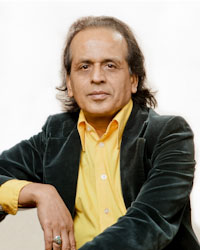
by Raghavan Iyer

Orienting by Desire: Visions 

Keyhole in wall with drawing business concept

In my previous discussions of the constraints on the Gift of Set and the extended exploration of how those constraints inform our Challenges, I mentioned Ipsissimus Flowers’ “Awaken, See, Act” formula. In its basic form, it means Awakening to present circumstances, Seeing what is actually occurring, and then taking Action. In following this formula, you will be far ahead of nearly any other human you encounter. 

As training in applying this formula, learning to See while choosing not to Act can be valuable. It starts to provide a sense of how the autopilot functions operate. You may even find yourself impressed by the sophistication and power this autopilot system has upon you and the world. And when you do begin to Act, you will likely find that the autopilot system does the majority of the work at following through on those actions. 

Yet there is another power of Seeing undisclosed in this formula. 

Seeing what exists is essential, and having a view of this at a high level of clarity is one of the critical things a Setian seeks to develop. However, seeing what exists as it presently “is” is also a place to see what it might become due to your Will guided by your Desire. In the moments of Awakening, being able to See in this manner, which we will call Visions, sets in motion the potential for conscious and unconscious actions aimed at making the Vision into reality. 

The more fully developed, informed and expressed a Vision, the more power it can exert while Sleeping and when Awakened. The next phase of Orienting by Desire will be crafting your Visions internally (physical, emotional, intellectual) and externally (ecology, community, culture)that will guide you in integrating the subsequent phases of my writing and guiding your overall Work. 

Go back to one of our earliest exercises, where you wrote out your Goals and then developed them into Visions. Also, look over the notes from our work on Challenges and the kinds of constraints that you experience in your life. See how your present understanding of your constraints and Challenges informs your thinking about your original Visions. How do they change? How do they interconnect? How can working in one area affect what is happening in another area? 

Now, write out your current Visions internally in all three dimensions and externally in all three dimensions. Have at least one Vision, three to seven words, clearly written so that someone can understand it and verify if it occurs. Do not take too long on this, as this is simply the first of many iterations. For now, we are simply learning the primary form of this exercise. Perfection of your Vision doesn’t matter. The connection of it to your Desires does. 

Like other things, this, too, will evolve and increase in its sophistication.

The Elusive Obvious: Dialectics

The ideas of economists and political philosophers, both when they are right and when they are wrong are more powerful than is commonly understood. Indeed, the world is ruled by little else. Practical men, who believe themselves to be quite exempt from any intellectual influences, are usually slaves of some defunct economist.

John Maynard Keynes

In the 19th Century, a significant shift in European Philosophy was inaugurated by Georg William Friedrich Hegel and the subsequent influence of his ideas upon German Idealism and then the wider world. Like many ideas of the past, he influences people regularly without their awareness that their thoughts owe part of their architecture to his ideas. 

The significant contribution Hegel has provided is an approach to understanding thought referred to as a dialectic approach formed by the triad of thesis, antithesis, and synthesis. A proposition is presented as a thesis. A reaction to this thesis via conflict or negation occurs as the antithesis. Finally, integrating the thesis and antithesis into a new understanding emerges as the synthesis. This relatively simple concept seems obvious to us who live in its wake. Still, Hegel’s articulation caught minds like a fever. 

Perhaps no thinker was more influenced by conflict and synthesis than Fredrick Engels. Engles drew inspiration from the Scholastic Laws of Thought and reacted to them by proposing what have become known as his Laws of Dialectics. These are: 

The Law of the Unity and Conflict of Opposites or Conflict 

Engels saw the world as fundamentally materialistic; however, this unity produces change through the polarization of forces and conflict between them. As Engels was a Socialist, a good way of understanding this would be by looking at the conflict between the laborers at a factory and its management. If either side had purely their way, chances are the unity of the factory would cease to function. The factory can stay productive and adaptive only through its continued conflict and adjusting to its changes. The same could be said for a herd species and its primary predators. As long as the two forces stay in conflict, each has the mutual benefit of continued survival and adaptation. If either group comprehensively defeated the other, it would lead to an ecological crisis and the ultimate death of the “victors” due to scarcity of resources. A herd without predators will multiply and consume the ecology’s resources. A predator that killed all of a herd would quickly find it without food. It is only through their conflict that the greater unity of life continues. 

The Laws of the the Passage of Quantitative Chance into Qualitative Change Transformation 

Simply put, as items increase, some means of change in their qualities will appear. The usual example of this from nature is in the phase transition of matter, with water being the most straightforward example. If the quantity of temperature increases, it will change the qualities of matter: solids will become liquids, liquids will become gases, and gases will become plasma. Lower temperatures and the same sequence of qualities will change in reverse. 

The Law of Negation of the Negation or Negation 

To continue a material change, all things will, in time, negate themselves. Individual organisms taking actions to ensure their survival will eventually take actions that lead to their death. In a sense, this Law suggests that eventually, any individual or system will result in its undoing simply by its continued operation as it is. 

With judicious and selective uses, these ideas can be reasonably powerful in analyzing systems and interactions within a system. It is perhaps one of the great ironies that the field in which Conflict, Transformation, and Negation have the most considerable influence, usually unstated, is in the realm of Business. However, purely Dialectic thinking can lead to significant issues as well. 

Because of its emphasis on conflict, Dialectic approaches can make it seem like antagonism is inevitable and inherently valuable. It can also provide grounds for the belief that conflict is inevitable and the only productive way to create change. Correlative to this, the notion that using force is the primary means of solving problems can become fixed. Due to the lack of any temporal restraint on these Laws, it becomes easy for Dialecticians to think there are limitless resources and time for actions to lead to their idealized outcomes. It also can lead to an obsession with quantity, as if mere acquisition alone would be all that was needed to create change. 

Chances are you have not actively studied the Laws of Dialectics. However, patterns of thought created by it are likely in your experience. How often do you immediately say, “I disagree,” whenever you hear someone state their opinion? How often do you find yourself repeating the same thing again and again, expecting a new outcome? How often do you find yourself taking actions that ultimately undermine your purposes? 

Seeing the roots of specific patterns and taking steps to use them consciously can help to ensure that the specters of history do not haunt your mind.

The Elusive Obvious: The Hazards of “Is”

When looking into human stress responses, I learned about one of the odder side effects of the Gift of Set several years ago. Unlike nearly every other animal on the planet, which only experiences stress under conditions of actual threat, humans can be stressed chronically. The root of this comes from one of the critical features of the default conditions of the mind: we are not capable of differentiating between internal-symbolic experiences and external experiences. In other words, if you have someone visualize being attacked by a tiger enough, their bodies will react as if they were being attacked. 

Much of the nightmares of human history derive from this same confusion between external conditions and internal symbol structures. Because our minds do not easily distinguish the two, it has been common for humans to invent symbol structures and mistake them for external realities. They will even forget that these things were the product of human action and attribute them to gods or other figures of myth. They will fight for the “reality” of these symbol structures, kill for and die for them. 

This muddling also underlies much of how hypnosis works. Streams of words are produced, using the blurred lines between visualization and actions to create a condition of susceptibility where people begin to act upon the provided visualizations. This feature is vital to Greater White Magical practices. 

This blurring capacity is not something to be fought but rather something to be retrained. There are situations where entering into symbolic structures is essential and valuable. Knowing how to disengage this capacity and then use it at will forms the first step towards making it a tool of the Gift. 

Setians have a clear advantage in working to make this capacity a tool of the Gift. The Setian Theory of the Universe builds upon a core distinction between objective and subjective. The distinction can be thought of as this: 

A consistent, ordered realm of objects exists that is measurable, analyzable, and understandable. However, at present, the extent to which this realm has been fully understood by humanity may only be in its infancy. We term this the objective universe. It can and should be studied via the material sciences such as physics, chemistry, and biology. While specialized qualifications are not necessary, some fundamental conceptual knowledge of these sciences should be pursued by anyone seeking to be an Initiate. 

In addition to this objective universe, each being can perceive a subjective universe unique to them. This subjective universe comes from an interaction between the objective universe and the individual being and, as such, has a process of deletion, distortion, and generalization inherent in its process of perception. As such, the subjective universe of a given individual may be highly similar to the objective universe or radically different than it, but the subjective universe of any individual is not and cannot be the same as the objective universe. 

As a human being, your subjective universe generates via your senses, which can perceive within a limited bandwidth of phenomena. This sensory information then becomes put through a process of interpretation, generating what could be thought of as a kind of “Graphical User Interface” or “GUI” that seems to you to be the only universe that exists, i.e., the one you are experiencing. 

Mechanisms outside the control of most people influence this GUI’s generation process. While there are a myriad of processes at play, a few key ones are Perspective processes, Belief processes, Model processes, and Narrative processes. These processes will become the subject of future posts. 

For most people, the difference between the subjective and the objective is not something that I have worked to learn. What they see is what they believe. This trait can be exploited in relatively benign ways through Stage Magic or more malignant fashions in the realm of confidence schemes, politics, and religion. Learning to differentiate events in the objective universe from your subjective experiences can help make you less susceptible to being mistaken and manipulated. 

One of the key features, both in the blurring of perception with reality generally and in hypnotic settings, is the use of what Alfred Korzybski referred to as “The Is of Identity.” The Is of Identity relies upon this blurring feature, where the symbolic term for an external event becomes mistaken for the fundamental identity of that external event. As Korzybski phrased it, it is mistaking the map for the territory or the menu for the meal. 

As an outgrowth of General Semantics, a technique known as Vernacular-Prime, or V-Prime, was developed. This approach calls for learning how to write without using conjugations of the verb “to be” with whatever Vernacular you primarily use. To do this, you must either provide verifiable, measurable notations like a scientist or situate your statements within your perceptions. Here are a few examples using English-Prime: 

Conventional: “It is raining.” 

E-Prime: “At the present moment, I observe rainfall.” or “It looks like rain.” 

Note: You may notice that the second statement requires both a time denotation of the observation and a reminder that an “I” is actively perceiving. The alternate uses a less robust statement but flows easier in regular conversation. 

Conventional: “Bach is better than any composer that ever was or ever will be.” 

E-Prime: “For me, Bach seems like the best composer of all time.” 

Note: A seemingly universal declaration becomes smaller and more contextualized as a given individual’s opinion. 

If you already keep a journal, consider writing in this manner for the next week. If you do not keep a journal, take ten minutes daily to write down some event or 

The Elusive Obvious: Logic

One of the foundational tools of the Gift of Set derived from, of all things, land use. 

In trying to understand how to utilize their lands best, the Egyptians developed a set of methods for understanding divisions of space and their relationships. These methods would become the foundation of the ideas brought to Greece by Pythagoras. The Initiatory School he established passed down this method to us as geometry. 

Egyptian geometry was primarily based on empirical observation and abstraction. If you had a triangular plot of land due to a river, and you could only measure two sides of the plot, they found that if you extended a square the length of one side and a square plot the length of the other and then added them up, it gave you a square the size you would get if you could plot a square off of the unmeasured side. As the Pythagorean Formula, the Greeks simplified this and abstracted it beyond land use. More importantly, the Greeks began to use known geometry to create proofs for unknown geometry, extending knowledge through using existing knowledge in new ways. The Greek use of proofs in geometry eventually extended toward creating proof methods for other activities. 

From this legacy, one of the most potent instruments of reason developed: Logic. 

Following the Peloponnesian War (431 to 404 BCE), with the defeat of Athens by Sparta, the need for proof took on new importance. Athens’s defeat had created severe issues related to ownership of property, repayment of debts, and settling interpersonal disputes. This was typically done by making speeches in the Agora of Athens, the center of the city and the heart of its lifestyle. Those speeches that worked best to settle disputes were arguments, and to help those seeking to craft arguments, a class of professional teachers of argumentation developed known as Sophists. This environment also produced one of the Sophists’ most essential critics and the father of European Philosophy, Socrates. Socrates, in turn, inspired his Athenian student Plato, who wrote accounts of Socrates’ ideas via dialogs, and Plato’s Macedonian student, Aristotle. 

To Aristotle, we owe the most significant debt in the development of Logic. He was a keen observer of humans and nature, relying upon empirical methods in a way that neither Socrates nor Plato had. He focused this capacity for observation upon the practice of argument and whether arguments made were sound or if they were fallacious. His works in this area, especially Prior Analytics and On Interpretation, laid the foundation for what became known as “term logic.” 

Of the various ideas developed by Aristotle, three fairly necessary tests for an argument have been the most influential. The first test is whether the terms maintain the same meaning throughout the argument. If it does, then it may be a sound argument. If the arguer suddenly changes the meaning midway through the argument, it is a flawed argument. The second test was whether the term was used in a contradictory way in the argument. The argument can be seen as sound if there is no contradiction. Finally, the terms of the argument must be clearly defined. Either the term exists for the sake of the argument, or it does not. There can be no middle ground within the argument. 

With these pretty simple ideas, arguments can be evaluated. In the process, we can get closer and closer to good reasoning and perhaps an understanding of truth. The history of these ideas took a strange turn in the Medieval Period when the Catholic Scholastics rediscovered Aristotle’s Logic. The Scholastics derive from Aristotle’s Logic what has become known as the Laws of Thought. These are: 

• The Law of Identity (For any Proposition A: A=A) 

• The Law of Non-Contradiction (A cannot both A and Not A) 

• The Law of the Excluded Middle (There is either A or Not A, nothing more)

These Laws simplify and focus Aristotle’s observations and inferences in pure term logic. Unfortunately, perhaps the Scholastics made a mistake that Aristotle did not. They turned these tools for testing the soundness of arguments into the Laws of Reality itself. As a result, the vast and wild field of Scholastic determinations about reality began, and a kind of intellectual fundamentalism overtook European thought for several centuries attributed to, but not evidenced in, Aristotle’s Legacy. 

The true power of logic as a Tool of the Gift can be restored when it is returned to its proper footing: as a tool for evaluating arguments. As a starter text, A Rulebook for Arguments by Anthony Weston offer comprehensive advice. In addition to this, semi-regular use of logic puzzles can help hone your skills in applying logic to abstract and practical situations. Finally, learning to apply logical methods to test the soundness of your ideas is indispensable to keeping yourself from needlessly falling into delusion.

The Elusive Obvious: Introduction

Unless you engage in a practice specifically related to it, you probably never really think about your breathing. Since you were born, you have always done it, as if the lungs were designed to breathe themselves. Similarly, in humanity’s default conditions, most people never think about thought. Their minds have always thought as if they were designed to think itself.

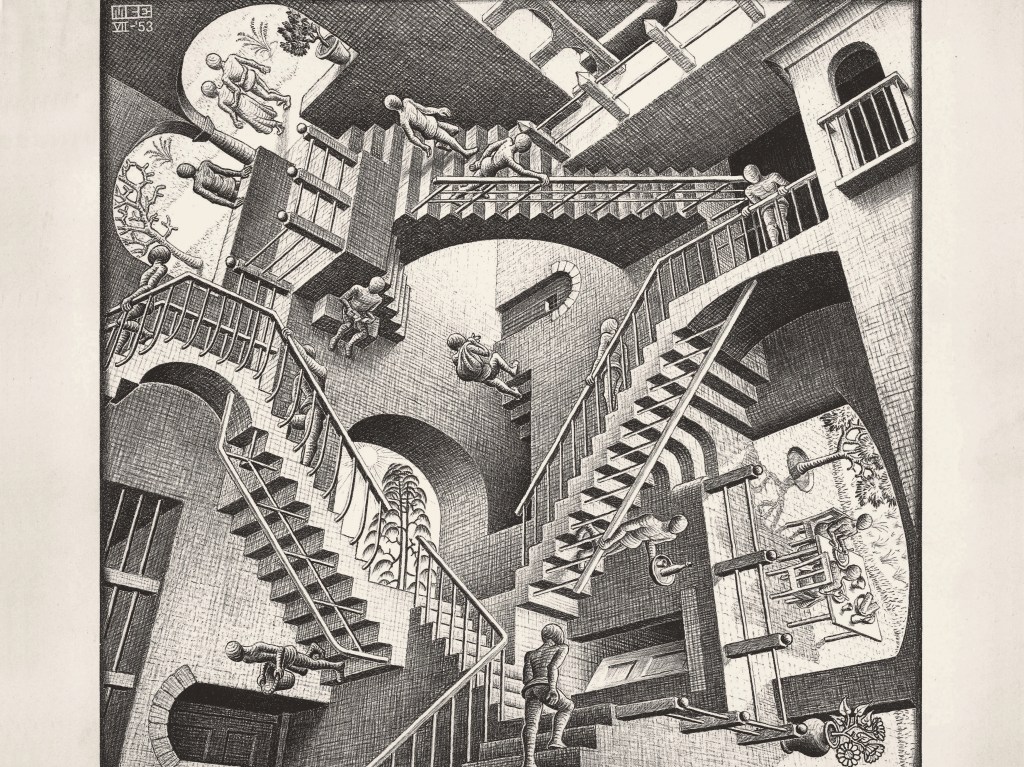
Roughly speaking, this is, in fact, the situation. The mind thinks without much reflection and will do so on its own for a lifetime without self-reflection. It often takes some outside impact or influence to start the process of thinking about thinking. If that process starts, all sorts of oddities arise, as this kind of reflexive thought can lead to recursive feedback. Think of the illustrations of M. C. Escher, and you can catch a glimpse of this kind of feedback feeling.

Many of the most impressive feats produced by humanity’s use of the Gift of Set have been taken for granted. Because of their ubiquity, or to the ubiquity of lip service to them, they have become part of the water in our collective fish tank. They exhibit a condition that Moshe Feldenkrais called “The Elusive Obvious.”

Perhaps the most susceptible to this condition is how the Gift of Set can be trained, transformed, and extended to better account for the totality of reality. The primary reason that this gets lost is that we, in our default conditions, assume we already have the qualities that this kind of training provides. This is a defense mechanism against having to expend the energy of learning new skills and developing the abilities we ascribe to ourselves but for which we have not. What are some of these abilities? Reason, Will, and Self-awareness are among them. So are the abilities to See and Act effectively in those rare instances when we manage to Awaken.

To develop these abilities, specific tools exist. These were developed over the centuries by others but only of find value in your use of them. A few of these may seem “mundane,” as if there was nothing new or of value there for a Black Magician, or that these are things that you already know. Perhaps they are. However, I would keep in mind P.D. Ouspensky’s comment in The Psychology of Man’s Possible Evolution:

I found that the chief difficulty for most people was to realize that they had really heard new things, that is, things that they had never heard before.

They did not formulate it for themselves, but in fact they always tried to contradict this in their minds and translate what they heard into their habitual language, whatever it happened to be. And this certainly I could not take into account.

I know that it is not an easy thing to realize that one is hearing new things. We are so accustomed to the old tunes, and the old motives, that long ago we ceased to hope and ceased to believe that there might be anything new.

And when we hear new things, we take them for old, or think that they can be explained and interpreted by the old. It is true that it is a difficult task to realize the possibility and necessity of quite new ideas, and it needs, with time, a revaluation of all usual values. 

I cannot guarantee that you will hear new ideas, that is, ideas you never heard before, from the start; but if you are patient you will very soon begin to notice them. And then I wish you not to miss them and to try not to interpret them in the old way.

Constraints: Further Readings

This post marks the end of the section about some constraints upon the Gift of Set. As such, I would like to share further reading suggestions for those interested. As with all things Setian, these are suggestions, not prescriptions. You are free to pursue or ignore them as you see them resonate with your Work. For now, I will simply be listing titles. When this series is complete and collected, expect a more expanded discussion of the titles in a manner akin to the Temple’s Reading List. 

Part 1: Constraints 

The Evolving Self by Mihaly Csikszentmihalyi 

Behave by Robert Sapolsky

The Accidental Homo Sapiens: Genetics, Behavior, and Free Will by Ian Tattersall and Rob DeSalle

The Story of the Human Body by Daniel Lieberman

The Invisible Gorilla by Christopher Chabris and Daniel Simons 

How the Mind Works by Steven Pinker 

Caveman Logic by Hank Davis 

Predictably Irrational by Dan Ariely 

Present Shock by Douglas Rushkoff 

Our Inner Ape by Frans de Waal 

The Human Zoo by Desmond Morris 

Understanding Culture by Philip Carl Salzman 

Culture in Mind by Bradd Shore 

The Meme-Machine by Sue Blackmore 

Spent: Sex, Evolution, and Consumer Behavior by Geoffrey Miller 

Influence: The Psychology of Persuasion by Robert Cialdini

Functional Training and Beyond by Adam Sinicki

Orienting by Desire: External Structures 

Take a look at your challenges, especially your external Challenges. Now, apply your insights from the most recent discussions around external structures and apply them to your Challenges. Maybe you have noticed that boredom and an under-enriched “Human Zoo” has been a major factor in the persistent depression you have been experiencing. Perhaps our inability to concentrate on your intellectual tasks results from undue stress in other areas of your life, clipping away at your working memory. Re-write your Challenges as a result of your insights. 

This will be our last pass through our Challenges, at least for this series. What you now have before you is something very few people have ever seen: their most significant Challenges outlined in detail in their hand. Even if this is as far as you ever get in the Orienting by Desire aspect of this writing, you are not light years ahead of nearly everyone you have ever met or will ever meet.

Constraints: Working Memory and Span of Control

Human awareness has operating limitations built into its structure. Perhaps the most widely known was discovered by George A. Miller in 1956 concerning “working memory.” Through empirical studies, Miller found that participants could keep between five and nine elements in their working memory, with seven being the average. This leads to a simple formula, “7 ± 2,” which is featured in most Psychology textbooks, sometimes referred to as Miller’s Law.

Miller’s Law showed something else as well. To handle information sets larger than nine units, the mind can use abstraction to cut up the data into chunks it could handle. Miller defined “chunks” as the largest meaningful unit in the material that people can recognize. Once chunked, the material could be treated as a single unit and tended to follow the same “7 ± 2” pattern. Individuals each had their own strategy and criteria for chunking data sets, but that they chunked was universal.

The variation in working memory appears to be subject to stress. The more stressed a person is, physically, emotionally, or mentally, the lower their working memory capacity. The more relaxed a person is, the greater their working memory capacity. While not directly connected, this fits with personality patterns as well, with people under stress acting least developed, people having a “normal” condition of personality, and people finding their personalities displaying “higher” characteristics in conditions of intimacy and relaxation.

This limitation of working memory influences nearly all structures created by humans, especially social organization. Humans are relatively adept at consensus in small groups, with six being the easiest for group decision-making. When a group reaches nine members, it has more significant difficulties reaching a consensus, and its deliberations are more prolonged. At ten individuals or higher, consensus becomes increasingly impossible at an equal level. To cope with this breakdown of consensus, a form of “chunking” occurs where one individual begins to take on a leadership role that can correlate the lower-level members’ ideas and make the final decision for the group.

Iterating outwards from this simple form of leadership, if group sizes get larger, a set of representatives to act as leaders for a subject will emerge. These representatives act as a new five to nine-member group, making decisions by consensus. If this group gets too big, one of its members will need to take up a new leadership level.

There does not seem to be an end to this complexification process. Evidence of this pattern can be seen in the various places where complex civilizations have emerged, such as Mesopotamia, Egypt, China, India, and Mesoamerica. Like individuals, societies reduce or expand their capacity for complexity based on the level of stress they are experiencing, whether internal or external. A culture’s aggregate “personality” will also display a similar shift from lower-normal-higher in situations of stress or relaxation.