Component Modeling
A powerful modeling tool has been woven into this series thus far. It is the way of looking at the world through the six physical, emotional, and mental dimensions of the self-complex, with ecology, community, and culture as dimensions of the external world. Each of these layers has an interactive effect on the others. What you do physically interacts with your emotional conditions and mental capacities. Externally, conditions of ecology have effects on community relations and cultural contributions. These two interactive fields also affect each other, with internal conditions affecting external conditions and the reverse.
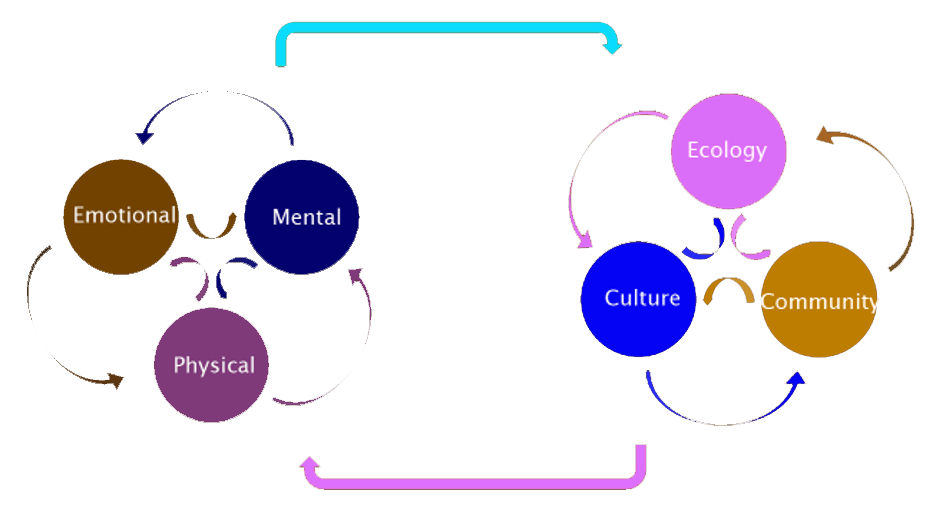
Consider for a moment the Visions you have developed so far in doing the exercises of this series. How do they interact in the manner of this model? How are your physical activities getting in the way or helping your sense of emotional satisfaction? Your mental creations? How are your external circumstances affecting your internal conditions? Are there elements of your Visions in different dimensions that are actually working at odds with one another?
Big models like this can be challenging, but some smaller component models can be helpful. The simplest component models have two components, with an interaction result arising between them. This model can be used to see a sense of the interaction systems occurring and try to identify the results of these systems.
Let us create an example of this. To create specific results, let’s examine how a hypothetical physical behavior interacts with an emotional experience.
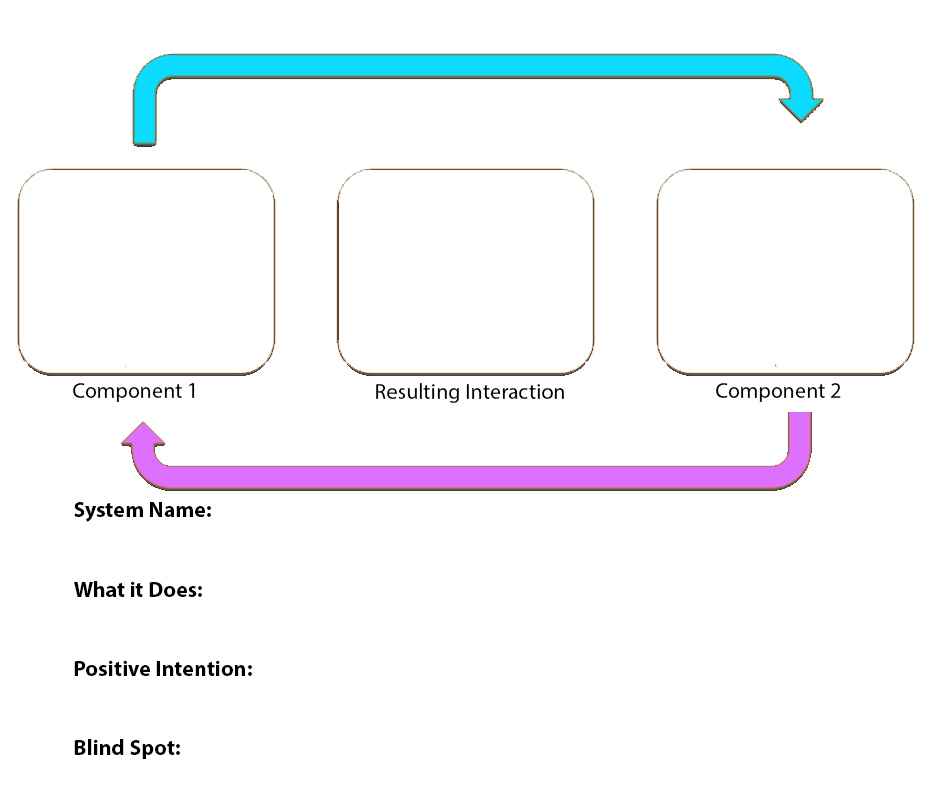
Let’s say that under stress, you like to consume fatty, salty, high glycemic index carbohydrate snacks. If it gets awful, you’ll go for an entire bag of Doritos. You’ve had a bad day at work; you come home, eat an entire bag of Doritos, and then sit on the couch watching whatever is on TV. In “Component 1,” write “Eat Doritos when Stressed.” Now, consider how this affects your emotions. The fatty, salty, carb snack initially makes you feel good and alleviates some of your stress response. Still, afterward, you find that you feel bad, and that feeling bad has you ruminating on the things you feel you can’t change that are causing you stress in the first place. Write in “Component 2” “feeling bad about myself and my circumstances.” How do these two things interact, and what do they result in? Well, your ability to handle emotional stress is lower, making it more likely that you’ll use your coping mechanisms of eating things like entire bags of Doritos, leading to a rather sullen person without physical or emotional happiness.
The funny thing is this whole system exists for positive reasons. The eating of the Doritios is driven by an evolutionary mechanism for coping with stress in the moment. It is designed to make you feel better for a little while and to increase your caloric storage in case stressful events have a negative impact on your food supply. The emotional reactions of feeling bad about eating and ruminating on your stress sources similarly are trying to help you. Yet, taken together, they lead to an unintended result that doesn’t make you happy.
Additionally, this system has built-in blind spots. Once locked into its interaction, the system of behaviors and results is no longer aware that what it is doing is increasing your stress and susceptibility to stress. It simply cannot see it, and it works hard to ensure you do not see it.
There are better ways to design component systems intentionally. The first one most aligned with what I have been driving in this series is placing one of your Visions as the interaction result and thinking about the components and how to structure their interaction. The two most powerful components to consider are your individual will, or those things you can control, and the conditions you are directing that will/control towards trying to create. In thinking about this, use your Vision to guide the system’s design. This can be done within a given dimension, across internal dimensions, and across internal and external dimensions. You can look at how physical control efforts can create certain cultural conditions, for example, or how community activities can change your mental conditions.
As an exercise, consider a system that already exists in your life. Identify two components, perhaps one behavioral and one conditional, and what they cause to arise due to their interactions. Consider what this system does in some detail. Then, consider what the positive intention runs behind the system’s operation. Then, try to see the blind spot that the system operates through. Finally, give the system a name or draw an image to represent it if you are inclined.
Next, choose one of your visions and place it in the interaction result box. Consider it for a moment and identify something you can control to help make this Vision a reality. Consider what conditions would be needed for your Vision to become a reality. When you have these identified, let them run in your mind and see if they enhance or diminish your Vision. See what this system would be doing overall, what the positive intention behind the system would be, if it is aligned with it, and finally, what blind spots it might create that you would need to be mindful of.



 Setemheb