Unless you engage in a practice specifically related to it, you probably never really think about your breathing. Since you were born, you have always done it, as if the lungs were designed to breathe themselves. Similarly, in humanity’s default conditions, most people never think about thought. Their minds have always thought as if they were designed to think itself.
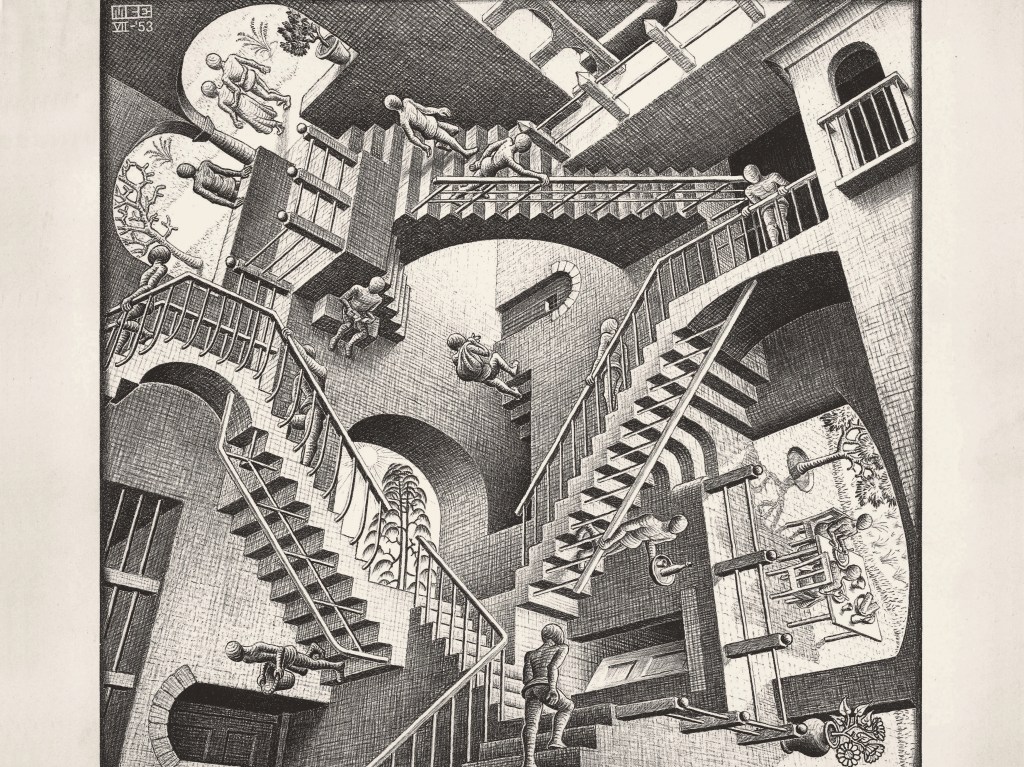
Roughly speaking, this is, in fact, the situation. The mind thinks without much reflection and will do so on its own for a lifetime without self-reflection. It often takes some outside impact or influence to start the process of thinking about thinking. If that process starts, all sorts of oddities arise, as this kind of reflexive thought can lead to recursive feedback. Think of the illustrations of M. C. Escher, and you can catch a glimpse of this kind of feedback feeling.
Many of the most impressive feats produced by humanity’s use of the Gift of Set have been taken for granted. Because of their ubiquity, or to the ubiquity of lip service to them, they have become part of the water in our collective fish tank. They exhibit a condition that Moshe Feldenkrais called “The Elusive Obvious.”
Perhaps the most susceptible to this condition is how the Gift of Set can be trained, transformed, and extended to better account for the totality of reality. The primary reason that this gets lost is that we, in our default conditions, assume we already have the qualities that this kind of training provides. This is a defense mechanism against having to expend the energy of learning new skills and developing the abilities we ascribe to ourselves but for which we have not. What are some of these abilities? Reason, Will, and Self-awareness are among them. So are the abilities to See and Act effectively in those rare instances when we manage to Awaken.
To develop these abilities, specific tools exist. These were developed over the centuries by others but only of find value in your use of them. A few of these may seem “mundane,” as if there was nothing new or of value there for a Black Magician, or that these are things that you already know. Perhaps they are. However, I would keep in mind P.D. Ouspensky’s comment in The Psychology of Man’s Possible Evolution:
I found that the chief difficulty for most people was to realize that they had really heard new things, that is, things that they had never heard before.
They did not formulate it for themselves, but in fact they always tried to contradict this in their minds and translate what they heard into their habitual language, whatever it happened to be. And this certainly I could not take into account.
I know that it is not an easy thing to realize that one is hearing new things. We are so accustomed to the old tunes, and the old motives, that long ago we ceased to hope and ceased to believe that there might be anything new.
And when we hear new things, we take them for old, or think that they can be explained and interpreted by the old. It is true that it is a difficult task to realize the possibility and necessity of quite new ideas, and it needs, with time, a revaluation of all usual values.
I cannot guarantee that you will hear new ideas, that is, ideas you never heard before, from the start; but if you are patient you will very soon begin to notice them. And then I wish you not to miss them and to try not to interpret them in the old way.
 Setemheb