The Egyptian language is first dated by inscription to circa 3400 BCE. It is one of the oldest recorded languages among humans. It is classified as an Afroasiatic language (Hamito-Semitic in older sources). It shares features with related ancient languages such as Akkadian and Biblical Hebrew and contemporary languages such as Arabic, Amharic, and Hebrew. The liturgical language of Coptic Christianity, Coptic, is a direct descendent of Egyptian.
As with any language with such a long duration of use, Egyptian underwent several changes over time. When the rule changes appear to take on clear features, Egyptian linguists make distinctions within the language. For Egyptian, there are the following divisions:
- Archaic Egyptian (Pre- to Early Dynastic Period),
- Ancient Egyptian (Old Kingdom),
- Middle Egyptian (Middle Kingdom),
- Late Egyptian (The Third Intermediate Period),
- Demotic (Late Period through Roman occupation)
- Coptic (Roman time to the present)
Like most Afroasiatic languages, Egyptian is built around “verb roots.” In most cases, verb roots comprise three consonants that can be modified by shifting vowel sounds in speaking and specialized characters in hieroglyphic writing. There is a fairly complex system for categorizing verb roots. James P. Allen’s Middle Egyptian (2010) is one of the best learning sources for those interested in a detailed discussion.
The Eternal Word of Set, Xeper, comes from the verb root xpr or hpr. [1] The verb root hpr means most essentially “to evolve, to develop, to roll out of.” The “roll out” aspect is likely to be how the verb root became connected with its hieroglyphic counterpart representing the Scarab Beetle.

This glyph was based upon the animal Scarabaeus sacer, which is indigenous to Egypt.
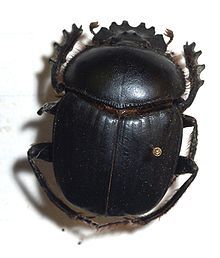
Like most other scarab beetles S. sacer is a coprophagic beetle that collects dung and rolls it off to be buried and used as a food source for itself and its offspring. You can find a brief video introduction to dung beetle behavior here. For those interested in diving deep into this topic Evolutionary Biology and Conservation of Dung Beetles by Clarke H. Scholtz et al. (2009) is excellent.
[1] Both the “x” and the “h” in this case signify a phoneme similar to the Scottish “-ch” in loch or the German “-ch” in Ich. Early Egyptological Linguists, such as those working in the 19th Century, tended to favor “x” while contemporary Egyptologists favor “h.”
 Setemheb