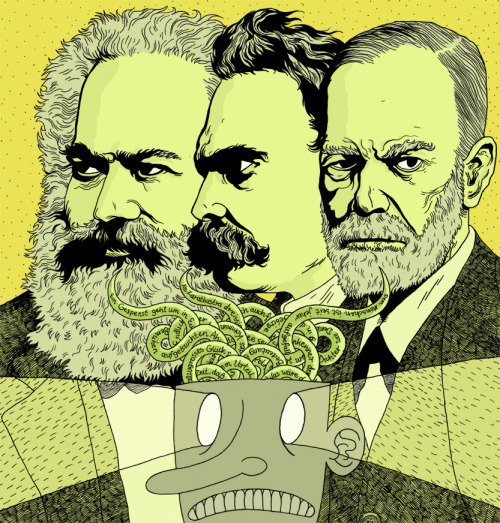
Several years ago, an Adept commented that Anton LaVey’s The Satanic Bible was a cynical approach to occultism. I countered that I saw it less as cynical than the first serious, magical response to those people Paul Ricoeur termed ‘The Masters of Suspicion.”
Who were the Masters of Suspicion? They were those figures who, at the end of the 19th Century, had cast profound doubts upon what had been up until them certainties about human nature.
Charles Darwin had cast profound doubts not only upon humanity’s unique place in the scheme of nature but the very need for a personal God to explain nature’s existence.
Karl Marx undermined the notion that human society was some sort of divine ordering by demonstrating rather clearly that it was the means by which society produced the good necessary to its survival that shaped its social organization.
Sigmund Freud undermined the sense that the self we identify with unreflectively was the only aspect of our being and that it behaved in a fully known fashion.
And finally, Friedrich Nietzche, an unemployed Philologist, had managed to undermine the entire scope of how Morals were constructed and how values are extracted from experience to inaugurate what became termed The Transvaluation of All Values. Even more potently, he set up for the realization that no bare facts exist apart from the ways that they are interpreted.
These messages, like most messages, never penetrated organized occultism. Crowley completely ignored them, except for the parts of Nietzsche he liked. Austin Spare accepted Freud’s subconscious and tried to fuck it. But no profound impact of these realizations would take shape.
LaVey, however, would be different. Darwin had been right; we were animals, and embracing that fact could free us from crippling guilts. Marx was not only correct, but his insight could be personalized so that the way your self was organized would reflect how you provided for the necessities of your life and lifestyle. Freud was right, and there was a vast storehouse of signs, symbols, and dreams to be mined for personal pleasure rather than unenjoyed shame. Nietzsche’s Transvaluation would require a kick to really get started, and what better way to do that than to take the embodiment of all those discarded values of the past, Satan, and embrace it as your own?
Rather than get into the historicity of this, let’s look at some practical applications:
1. Consider your own relationship to these Masters. What are your present understandings of biology, psychology, economics, and values? Have the doubts these figures raise been integrated into your understanding, or have they been unaddressed?
2. LaVey’s Utterance of Indulgence came at a time of broader social and personal upheaval. Spend some time looking at the events of the year 1966 and see if you spot anything that strikes you as indicative that something significant was on the horizon.
3. How comfortable are you with doubt? How do you account for the fact that regardless of how much you know, you will never know the entirety of all reality?
4. Look at any number of present conflicts in the world. How many of them appear to be, in part, those whose thinking is still in the dreams of our species’ childhood before these Masters now in conflict with those grappling, however poorly, with the awakening after them?
5. Take a look at your life and lifestyle. How are they shaping the being that you are Becoming?
6. Read a copy of Tim Ferriss’ The Four Hour Work Week. How could optimizing your pleasure through building a lifestyle reflective primarily of your desires transform that Becoming? What values do you think would emerge for you by doing this?
7. Read a copy of Mihaly Csikszentmihalyi’s Flow: The Psychology of Optimal Experience. How would building a lifestyle reflective primarily of creating circumstances where you could experience the kind of Flow State he described transform your Becoming? What values do you think would emerge by making this your central concern?
 Setemheb
One thought on “The Age of Satan and the Masters of Suspicion”