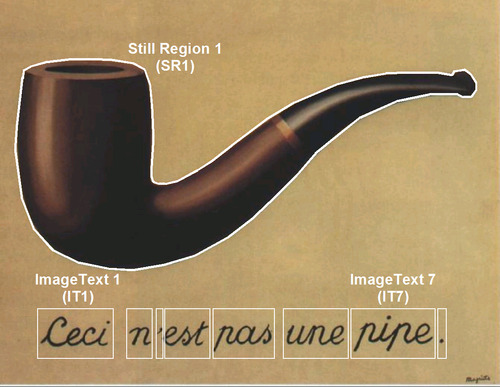
Acts of Magic, of whatever kind, are acts of Communication.
A Basic Model of Communication
One of the most valuable communication models was proposed in 1954 by Charles Osgood and Wilbur Schramm.
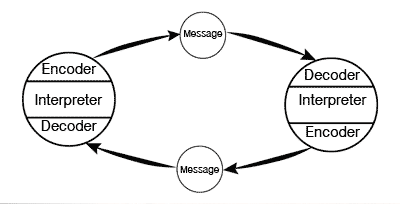
The most common in interpersonal communication is through language. Communication takes place between Interpreters with a cyclical exchange. In a single act of communication, one of the Interpreters acts as the Encoder. This individual takes some Message and puts it through a code. The encoded message is then transmitted in some fashion to the other Interpreter, who acts as the Decoder. As long as they know the Encoder’s code, they can decode it and receive the intended message. Once a cycle like this is complete, it repeats in the other direction, creating a circular feedback system.
You might notice a place where problems can arise. What happens if the Encoding Interpreter uses a code the Decoder does not know? In that situation, the Message will not be received at all. What happens if the Decoder only understands part of the code being used? They will delete and distort content from the encoded Message. They will likely generalize from what they do understand or have experienced in the past. This communication model will be the primary model I will be using throughout the discussion. I will add to it from other Communications Studies resources. Still, the Osgood-Schramm Model will be the basic I will return to repeatedly.
Communication Studies is a complex field with a curious history, drawing from psychology, philosophy, and other intellectual disciplines. It is outside the scope of this series to go into full detail. Still, I encourage you to do your independent research in this area.
This model shows that encoding is a central aspect of communication. Indeed, the creation of acts of magic comes from clearly identifying desires, seeing how to define them as intents, and then encoding this intent in a fashion that is resonant with your self of magic. For those fluent in a specific tradition or neo-tradition of magic, this process of encoding will often fit within the semiotic structure of that tradition. For this series, however, I assume you are not fluent in any tradition/neo-tradition. Thus, it would be best to devise your own means of encoding desires.
The practice of sigil magic is a practical, nontraditional way of starting. Regarding existing texts on sigil magic, Frater U.D.’s Practical Sigil Magic is the best primary text. Jan Fries’ Visual Magick is a worthwhile secondary text to challenge aspects of Frater U.D.’s thinking and thinking to expand the potential media for practice.
All sigil magic follows a relatively simple formula. Identify a desire and turn it into a declarative statement of intent. These are best formed as positive statements. There is a substantial benefit to forming these statements in a manner that J. L Austin termed a “performance utterance” in his seminal How to Do Things With Words. Once the statement has been formed, it is put through a process of encoding. These encodings can be via nearly any media. However, the two most common are visual and auditory, with kinesthetic or gestural methods less commonly discussed in the literature on sigil magic.
Once the sigil is formed, it is then enchanted through an act of magic. A period of preparation takes place, a time for the act is determined, compression takes place, a frame rite is performed, and in this magical space, the sigil is charged in some manner appropriate to its communication. Once this is complete, the frame ritual is used to close, and the intent is let go of by the magician to work.
Much has been made in the literature on sigil magic regarding the importance of forgetting the sigil’s intent. This isn’t nearly as necessary as has been suggested. It is essential not to be obsessive about the intent and continually call it to mind. Much like a farmer, you need to trust that once you have planted a well-tended and selected seed, it will germinate on its own, provided they give it the proper soil.
This covers the first direction of communication, at least in terms of the Encoder and the sending of the message, but what are we communicating with? As discussed previously, our message has two potential targets: the Inner Ring of Perception to engage in Metamorphosis and the Outer Ring of the Objective to engage in Sorcery.
Dr. Flowers describes acts of magic drawn from the anthropologist Jan van Baal in his dissertation Runes and Magic.
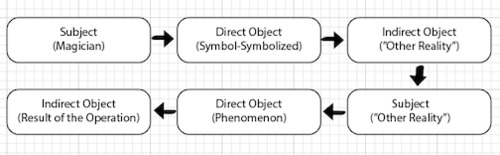
Van Baal sees magic as a two-sentence affair. The first is the Magician communicating their encoded desire to the other reality (Inner or Outer). The second is the response from that reality through phenomenon providing the result of the original communication.
Dr. Flowers provides an interesting typology for acts of magic that are worth considering when identifying your desires. These categories are:
- a) protection from destruction, forces, beings, etc.
- b) restoration of disturbed natural order, health, etc.
- c) preservation of natural order, health, etc.
- d) attraction of desired forces, beings, persons — invocations, evocations, love-magic, etc.
- e) destruction of intrusive forces, beings, persons — curses, etc.
- f) transformation of forces, beings, persons — initiation, shape-shifting, etc.
- g) perception of hidden reality — divination
It is important to note that these need not be isolated or exclusive categories. A blending of them is typical, such as attracting people capable of preserving a given project or looking to create the potential for transformation via the destruction of hindrances. Interestingly different traditions and styles of magic emphasize some of these more than others. Dr. Flowers notes that many surviving examples of runic magic deal with protection, restoration, and preservation. The magic of Anton LaVey, in contrast, deals almost exclusively with attraction, destruction, and restoration. You will likely find in practice that you rely more heavily upon some of these categories than others. This will provide you with both a sense of your strengths and those areas where you are weakest.
 Setemheb
One thought on “Theoria: The Essentials of the Semiotic Theory of Magic”