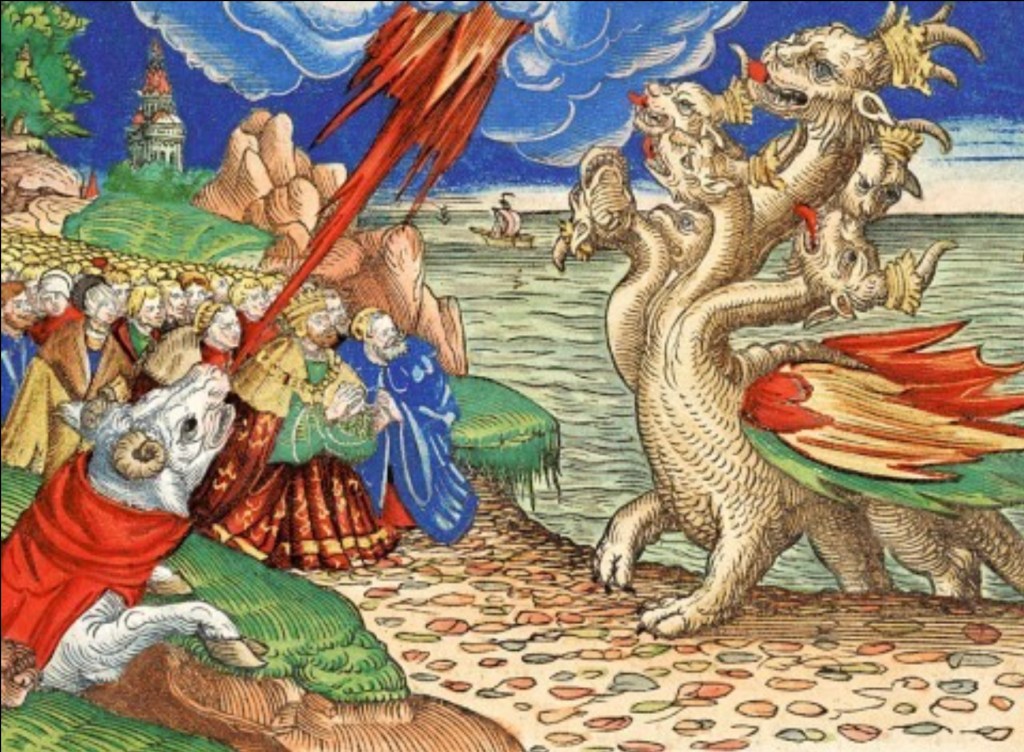
The Revelation of John stands out as perhaps the oddest document in the compilation of texts known as the Bible. If you have read that compilation, you realize how odd it is to stand out in that crowd. Of the books of the New Testament, its inclusion was the most controversial, and it was not included in the Eastern Church’s Canon. Elaine Pagels’ Revelations: Visions, Prophecy and Politics in the Book of Revelation is excellent for those interested in an in-depth analysis and history of the text.
Within the highly stable worldview of the Middle Ages, Revelations sat as the one means of radical change. With the arrival of the Final Kingdom, the old social orderings would be disbanded in favor of a new one with greater equality for the righteous. For most of this period, it was a tiny spark of hope, and that spark would take until the 12th century to cause a fire.
Joachim de Fiore (1135-1202 CE) was the first to catch fire. A member of the Order of Cistercians, Joachim was obsessed with piety, pilgrimage, and the Book of Revelation. He came to a doctrine that would rock the Medieval World through studying the text and his own mystic visions. The World for Joachim was seen not as a static thing but rather something which was developing, processing, in a relationship with the Divine. The Old Testament of the Hebrews marked the original development of humanity to the Divine, as one group alone had come into contact. This was the Age of the Father and was marked by the Patriarchal power of the Father and the story of his Chosen. Beginning with the birth of Christ, a new relationship was developed between humanity and the Divine. No longer was the message for the Chosen alone but rather for all those others. The Patriarchal rule of the Father gave way to the growth of the Church as representative of this new Age of the Son. Joachim realized that, like the Trinity of his God, there must be a third Age, the Age of the Holy Spirit, where the apparatus of the Church was dissolved as individuals came into direct contact with the Divine.
Joachim’s realization opened Pandora’s Box at the end of the New Testament. If the relationship between humanity and the Divine was not a finished project as had been thought but rather something still developing, then change was not only possible, it was the only way to bring about this Age. Various visions of what this would mean began to ferment around Western Europe, vying for attention and being subject to charges of heresy. Might women become the new rulers of this coming Age of the Spirit? Might the Antichrist attendant to the Revelation already be upon the Earth, or worse in the Church in Rome itself? Might the expansion of the Divine from the Chosen to the Gentile suggest that in this new Age to come, those far beyond Western Europe would need to be brought the Divine Message?
You can guess how well this message of the dissolution of the Church went over in Rome. Indeed Joachim’s ideas became the target of the essential Catholic thinker of this period, Thomas Aquinas, who made special efforts to undermine their influence in Summa Theologica. But it was too late; the idea was loose in the culture that not only was change possible, but the Divine demanded it. This desire for the fulfillment of prophecy began to seed religious and political ambitions as various kingdoms began to see themselves as the vehicle of this New Age and would serve as the Final Kingdom to rule the Millennium, as John of Patmos had told.
And into this frothy mix of Divine Revelations, the promise of a New Age, and political struggle came the Hermetica.
*For a complete discussion of the influence of Revelation and Joachim’s teaching, see Arthur Williamson’s excellent Apocalypse Then: Prophecy and the Making of the Modern World.
 Setemheb