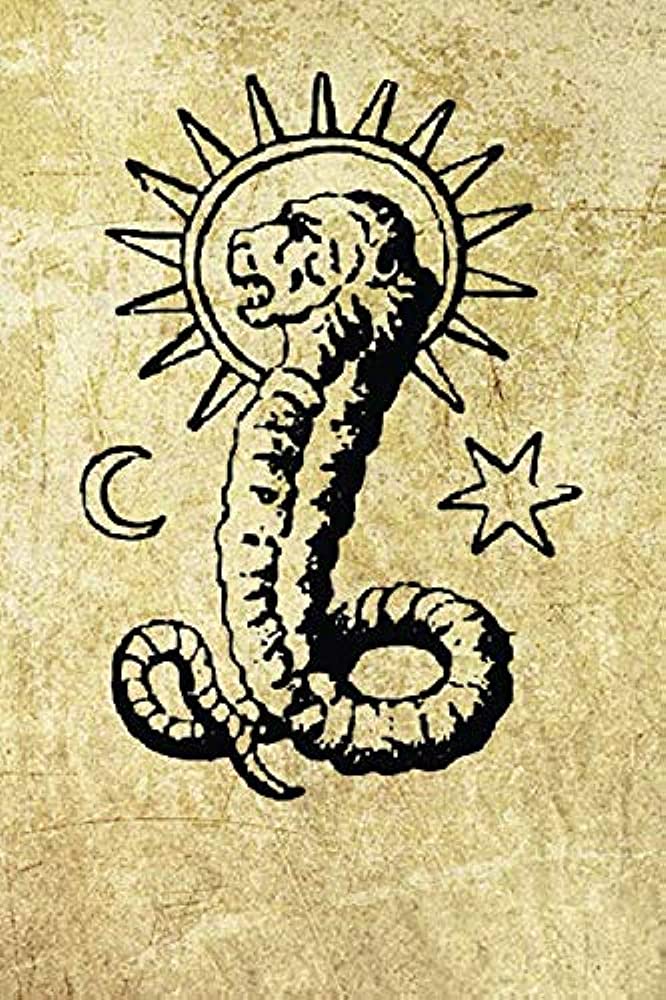
Another group of Gnostics, the Sethians, would contribute another critical concept to the cluster of ideas around the word “Aeon.” Until fairly recently, what was known about their beliefs came from the writings of Irenaeus, a Second Century Bishop of Lugdunum in Gaul. The Sethians’ focus was mainly on the period before the Creation Narratives in Genesis, seeking to understand the origins of God. They presented a largely negative theology, describing the immobility and ineffability of the Divine.
The Sethians shared with the Valentinians a belief in pairs of sexually charged Aeons emanating from the One. The first was Barbelo, referred to as “The Eternal Aeon.” Together God and the Aeons were in a Pleroma. Within the Pleroma, however, a crisis occurred, leading to a figure with a lion’s head on the body of a snake called Yaldabaoth. Yaldabaoth would steal the Divine capacity to create from the Aeon Sophia and use it as a demiurge, creating the material world separate from the fullness of the divine in the Pleroma. To do this, he spawns beings called Archons, who aid in building Materiality. The Yaldabaoth creates Adam, mistakenly leaving a portion of the divine power stolen from Sophia within this new being. This capacity would, in time, transfer to the third son of Adam, Seth, from whom the movement would take its name.
The actual thoughts of the Sethians were largely unknown until the discovery of the Nag Hammadi Library in 1945. As such, misapprehensions of their ideas and practices abounded in discussions of this sect. One of the Nag Hammadi Library texts is a set of hymns known as “The Three Stele of Seth.” These hymns praise Barbelo and outline a process of Ascension by the one singing the hymn from the material realm, up through the Aeons into the realm of Barbelo.
This process of Ascending demonstrated in “The Three Steles of Seth” would leave a mark on the practical methods associated with the Gnostics. It was held that they sought to return through the Aeons to the One and to do so that they must pass through the challenges of the Archons. Possibly based upon diminished knowledge of the Egyptian Book of the Dead, these Archons were thought to be passable through certain words and actions. Knowing the word to get past a particular Archon would provide you access to the associated Aeon.
Thus we have the origins of the relationship between Word and Aeon.
 Setemheb